Washington University in St. Louis School of Medicine Division of Biology and Biomedical Sciences Division of Biology and Biomedical Sciences
Division of Biology and Biomedical Sciences Division of Biology and Biomedical Sciences
Admissions Graduate StudentsPostdoctoral ResearchersAlumniFacultyDiversity
The Division and the UniversityThe Ph.D. Admissions ProcessGraduate ProgramsPathways and Other OpportunitiesSupport ServicesVisiting St. Louis

Biochemistry Program

Computational and Molecular Biophysics Program

Computational and Systems Biology Program

Developmental Biology Program

Evolution, Ecology and Population Biology Program

Human and Statistical Genetics Program

Immunology Program

Molecular Cell Biology Program

Molecular Genetics and Genomics Program

Molecular Microbiology and Microbial Pathogenesis Program

Neurosciences Program

Plant Biology Program

Program Directors


Biochemistry Program

Graduate Student Coordinator: Melissa Torres
Biochemistry Faculty Director: John Cooper
Biochemistry Program Guidelines
Biochemistry Program Website
Request Ph.D. Admssions Information

Research in biochemistry utilizes the concepts and approaches of chemistry to understand the molecular basis of biological processes. Fundamental chemical principles and techniques are used to understand the stability and specificity of macromolecular interactions as well as their mechanisms of action in processes such as DNA replication, signal transduction and gene regulation. The complexity of the biology makes the application of chemical principles challenging for the biochemist.

The focus of much biochemical research is on the molecular description of biological processes. Receptor-ligand interactions, macromolecular stability and assembly, as well as the mechanisms of enzyme catalysis, are of particular interest, since these are central to the function and regulation of all biological systems. Studies of the kinetics, energetics and dynamics of these interactions and the structures of the macromolecules involved provide the main experimental avenues that often are combined with theoretical approaches to obtain a molecular description of important biological processes.

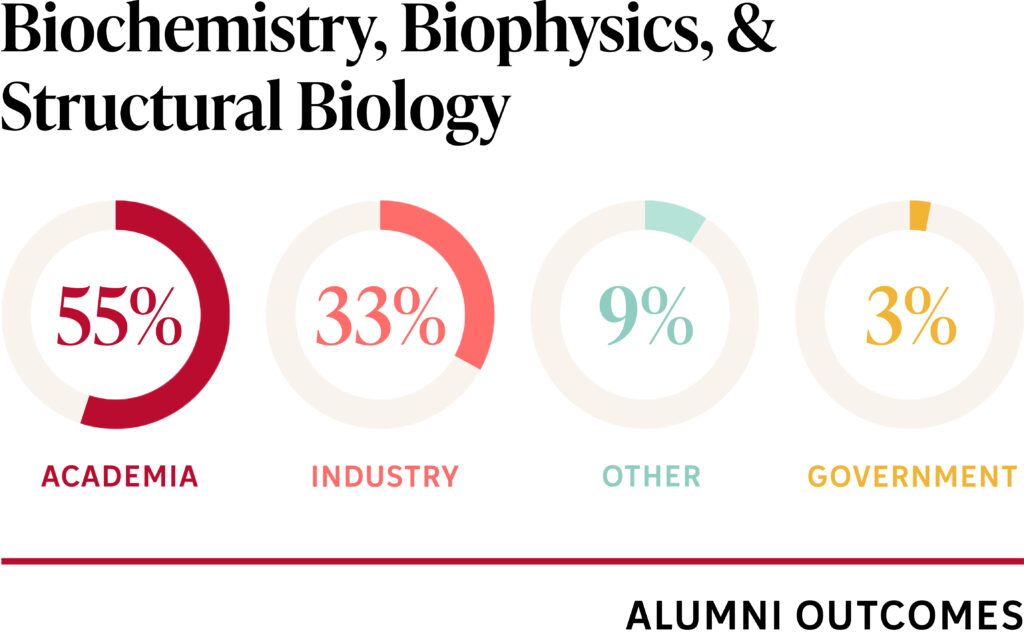
For information regarding career path and complete program guidelines, click here.

Program of Study

Biochemistry students enroll in four to six courses and participate in three laboratory rotations in the first year.

Course Requirements:
Chemistry and Physics of Biological Molecules (Bio 5357)
Biochemistry Student Seminar (Bio 5466)
Advanced elective (from approved listing)
Journal Clubs (3 credits)
Ethics and Research Science (Bio 5011)

2 courses from the following:
Organic Chemistry III (Chem 451)
Bioorganic Chemistry (Chem 453)
Nucleic Acids and Protein Synthesis (Bio 548)
Molecular Cell Biology (Bio 5068)
Immunology (Bio 5051)
Macromolecular Interactions (Bio 5312)
Cellular Neurobiology (Bio 5571)

Students participate in any of several journal clubs, such as:

Nucleic Acid-Protein Interactions Journal Club (Bio 5443)
Proteins Journal Club (Bio 5225)
Genetics Journal Club (Bio 5235)

Several seminars are presented by visiting scientists each week. Each of the departments, the Division of Biology and Biomedical Sciences and the graduate students organize seminar programs which feature invited faculty from other universities and research institutes. Advanced students regularly attend national and international scientific meetings.

Biochemistry Program Faculty

Samuel Achilefu, Ph.D. - Molecular optical and multimodal imaging and monitoring treatment response of diseases.

Carolyn J. Anderson, Ph.D. - Development of molecular targeted radiopharmaceuticals for cancer imaging and therapy.

Usha P. Andley, Ph.D. - Small heat shock protein functions in ocular systems and stress.

Jacques U. Baenziger, M.D., Ph.D. - Synthesis and function of unique carbohydrate structures as information-bearing macromolecules.

Wayne M. Barnes, Ph.D. - Improvements to DNA technology, applied to plant genetic engineering.

Roger N. Beachy, Ph.D. - Molecular and cellular basis of virus infection: Control via biotechnology.

Stephen M. Beverley, Ph.D. - Molecular genetics of protozoan parasite virulence.

Robert E. Blankenship, Ph.D. - Molecular mechanisms of energy storage in photosynthetic systems.

Kendall J. Blumer, Ph.D. - Signal transduction in the cardiovascular, nervous and visual systems.

Irving Boime, Ph.D. - Placental and pituitary hormone genes.

Thomas J. Brett, Ph.D. - Structural biology and molecular basis of lung diseases

George J. Broze, Jr., M.D. - Regulation of coagulation.

Peter M.J. Burgers, Ph.D. - Molecular Biology of DNA replication and repair in yeast.

Michael G. Caparon, Jr, Ph.D. - Genetics and virulence of the pathogenetic streptococci.

Emily Cheng, M.D., Ph.D. - Integration of apoptotic signaling cascades and the mitochondrion-sependent death program.

Peter T. Chivers, Ph.D. - Metalloregulation in microbes

John A. Cooper, M.D., Ph.D. - Molecular mechanisms of cell motility and cytoskeleton assembly.

Douglas F. Covey, Ph.D. - Medicinal chemistry of steroids.

Peter A. Crawford, M.D., Ph.D. - Integrating systemic metabolism into mammalian myocardial energetic homeostasis

Erika C. Crouch, Ph.D., M.D. - Structure and function of surfactant protein D (SP-D).

Nicholas O. Davidson, M.D. - Mammalian gene expression: Regulation through mRNA editing and RNA stabilization.

Enrico Di Cera, M.D. - Structure and function of proteases; protein engineering; allosteric enzymes

Marc I. Diamond, M.D. -

Allan Doctor, M.D. - Mechanism by which erythrocytes exert hypoxia-responsive control of regional blood flow.

Tamara L. Doering, M.D., Ph.D. - Investigations of capsule synthesis in the pathogenic fungus Cryptococcus neoformans.

Tom Ellenberger, D.V.M., Ph.D. - Structural biology and biochemistry of DNA repair, replication and recombination; chromosome maintenance.

Elliot L. Elson, Ph.D. - Mechanical properties of reconstituted tissues. Fluctuation spectroscopy of protein interactions.

William A. Frazier, Ph.D. - Thrombospondin-1/CD47 regulation of mitochondria, nitric oxide and cardiovascular function

Carl Frieden, Ph.D. - Protein aggregation processes

Eric A. Galburt, Ph.D. - Cotranscriptional RNA folding; Intron splicing; Transcription; Optical Trapping, Biophyiscs

Roberto Galletto, Ph.D. - Mechanistic studies of DNA motor proteins. Single Molecule Biochemistry.

N. Gautam, Ph.D. - Imaging signaling in living cells.

Daniel E. Goldberg, M.D., Ph.D. - Biochemistry of malaria.

Gregory A. Grant, Ph.D. - Relationship of structure to function in allosteric control mechanisms.

Kathleen B. Hall, Ph.D. - We study the interactions between RNA and its binding proteins.

Xianlin Han, Ph.D. - Identification of biochemical mechanisms underlying altered lipid metabolism, trafficking, homeostasis in neurodegenerative diseases and diabetic cardiomyopathy.

Phyllis I. Hanson, M.D., Ph.D. - Regulation of membrane trafficking

Jeffrey P. Henderson, M.D., Ph.D. - Biochemistry of the interface between hosts and bacterial pathogens.

Katherine A. Henzler-Wildman, Ph.D. - Functional importance of membrane protein dynamics

Keith A. Hruska, M.D. - Mechanisms and treatment of CKD and complications, renal osteodystrophy and vascular clacification.

Andrew J.W. Huang, M.D., M.P.H. - Corneal epithelial wound healing, neovascularization and stromal dystrophies

Scott J. Hultgren, Ph.D. - Pilus and amyloid fiber formation in bacteria: Structure, function and role in diseases of the urinary tract.

Jan G. Jaworski, Ph.D. - Biosynthesis and metabolism of plant fatty acids and lipids

Joseph M. Jez, Ph.D. - Structural biology and biochemistry of plants

Evan D. Kharasch, M.D., Ph.D. - Laboratory, translational and clinical investigations evaluate the role of drug metabolism and transport, and blood-brain and other tissue barriers, in drug disposition and clinical drug effects.

Petra Anne Levin, Ph.D. - Temporal and spatial regulation of bacterial cell division.

Amanda L. Lewis, Ph.D. - Sialic acid metabolism in commensal and pathogenic host-microbe interactions

Ellen Li, M.D., Ph.D. - Translational research in inflammatory bowel disease

Timothy M. Lohman, Ph.D. - Mechanisms of DNA helicases/translocases and SSB proteins

Robert H. Mach, Ph.D. - Imaging with PET Radiotracers

John E. Majors, Ph.D. - Replication of (+) strand RNA viruses.

Garland R. Marshall, Ph.D. - Molecular recognition is the key to drug design and peptide conformation.

Liviu M. Mirica, Ph.D. - Development of specific inhibitors of histone demethylases; design of therapeutic and imaging chemical agents for Alzheimer’s disease.

Kevin D. Moeller, Ph.D. - Developing new methods for peptide mimetic, natural product synthesis, and the construction of addressable molecular arrays

Eugene M. Oltz, Ph.D. - Genetic and epigenetic programs that guide normal lymphocyte development and contribute to cellular transformation.

Daniel S. Ory, M.D. - Study of regulation of cholesterol homeostasis, and role of cholesterol in atherosclerosis and neurodegeneration.

Himadri B. Pakrasi, Ph.D. - Systems Biology of photosynthetic organisms.

M. Alan Permutt, M.D. - Pancreatic islet cell genes and diabetes genetics research.

Linda J. Pike, Ph.D. - EGF receptor-mediated cell signaling and the control of cell growth

Helen M. Piwnica-Worms, Ph.D. - Cell cycle and checkpoint control.

Joseph L. Roti Roti, Ph.D. - Cell-cycle progression and response of the cells to ionizing radiation and heat shock.

Deborah C. Rubin, M.D. - Gut epithelial-mesenchymal interactions in ontogeny and in epithelial repair following disease-induced injury.

J. Evan Sadler, M.D., Ph.D. - Biochemistry and function of hemostatic proteases and von Willebrand factor.

Richard T. Sayre, Ph.D. - Characterization of energy transfer processes in photosystem II (PSII) reaction center complexes.

Jean E. Schaffer, M.D. - Cellular responses to metabolic stress.

Paul Schlesinger, M.D., Ph.D. - Intracellular ion transport, chloride, protons, mitochondrial channels, phagosome, parasites.

Clay F. Semenkovich, M.D. - Molecular and cell biology of atherosclerosis and diabetes.

Thomas J. Smith, Ph.D. - Use of x-ray crystallography to study viruses, toxins and enzymes.

Sheila A. Stewart, Ph.D. - Telomere biology in human cancer and aging.

Yinjie Tang, Ph.D. - Bioremediation of toxic compounds and metabolic engineering of environmental microorganisms for biofuel production

John-Stephen Taylor, Ph.D. - Structure-activity relationships in UV mutagenesis; nucleic acid-based chemotherapeutic and imaging agents

Robert E. Thach, Ph.D. - Ecology of vector-borne diseases.

Niraj H. Tolia, Ph.D. - Structural and biochemical characterization of malaria invasion proteins.

Douglas M. Tollefsen, M.D., Ph.D. - Biochemistry and physiology of protease inhibitors that regulate blood coagulation.

Heather L. True-Krob, Ph.D. - Epigenetic regulation of phenotypes by propagation of prions in yeast

Michael J. Welch, Ph.D. - Use of radiopharmaceuticals to evaluate receptor and enzyme levels in vivo.

David B. Wilson, M.D., Ph.D. - Role of transcription factors in differentiation and development.

Qin Yang, M.D., Ph.D. - Telomere recombination and maintenance, AKT oncogenic signaling

Zhongsheng You, Ph.D. - Molecular mechanisms of genome surveillance and tumorigenesis


Divison of Biology and Biomedical Sciences
Site Map Request Information Post a Seminar or Event Post a Job Give Contact Us