PhD training in Biomedical Informatics and Data Science (BIDS) at WashU is offered by the Division of Biology and Biomedical Sciences with faculty leadership from the Institute for Informatics, Data Science and Biostatistics (I2DB)
The mission of I2DB is to focus on the informatics, data science, and biostatistics landscape at WashU Medicine to transform research, education, and patient care. It emphasizes precision medicine and efforts to improve the quality of healthcare and public health initiatives locally, nationally, and worldwide.
The BIDS PhD program provides opportunities for graduate students with diverse backgrounds to gain expertise in the field of biomedical informatics, to train as future biomedical researchers and industry leaders in biomedical informatics and data science core competencies, and to engage in scholarly activities under the guidance of experienced informatics faculty. Beyond an educational program, the mission of BIDS is to support biomedical informatics practice through applied research in real-world settings.
The objectives of the BIDS program are to:
- Expand students’ knowledge in data science theories and applications in biomedical informatics;
- Provide training and hands-on research and industry experience in biomedical informatics and data science;
- Assist students in enhancing and applying their skills in translational science, real-world problem solving, and dissemination of knowledge;
- Encourage students to pursue careers in academia and/or industry through exposure to professional role models or mentors; and
- Develop and improve students’ skills in interdisciplinary teamwork and communication.
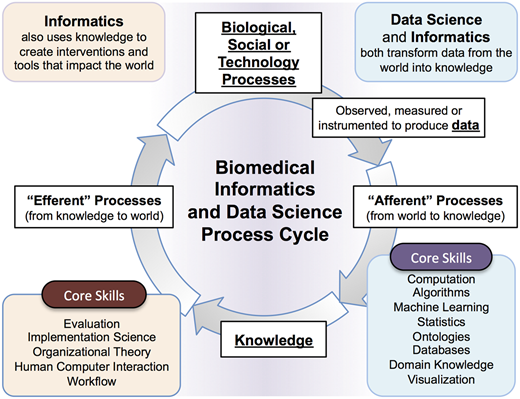
The BIDS program spans the fields of Data Science and Biomedical Informatics, which we define as follows:
- Biomedical Data Science is the study of the generalizable extraction of knowledge from biomedical data; and
- Biomedical Informatics is the science of information applied to or studied in the context of biomedicine.
(Payne PR, Bernstam EV, Starren JB. Biomedical informatics meets data science: current state and future directions for interaction. Jamia Open. 2018 Oct;1(2):136-41.)
Throughout their training, learners will interact with patients, providers, and the healthcare data ecosystem in addition to working at the bench. The BIDS program promotes collaboration and partnerships in solving problems in clinical practice, individual and population health, and biomedical research, through the optimal use of information. Due to its interdisciplinary nature, the BIDS program offers learners great flexibility when creating individual education plans based on interests, experience, and future goals.
Core research tracks and subfields
Biostatistics and Data Science
The goal of the Biostatistics and Data Science track is to train independent and innovative researchers who will contribute to the development and application of cutting-edge statistical and data science methodologies in health science disciplines. The track provides a balance of theory, methods, and applications of biostatistics and data science that are central to modern interdisciplinary research. Under the supervision of advisors, PhD students participate in the design of clinical studies and are involved in the analysis, inference, and interpretation of these studies.
Biomedical Informatics
Through the Biomedical Informatics track, students will have training and research opportunities in the five subdisciplines of biomedical informatics, as defined by the American Medical Informatics Association (AMIA):
- Applied Clinical Informatics (ACI) focuses on supporting and elevating clinical informatics practice through research translation, which is essential to fill the gaps between practice and research. ACI involves the application of innovative measurement and informatics approaches to inform and improve clinical practice.
- Consumer Health Informatics (CHI) involves views from consumers or patients and focuses on information structures and processes to empower individual’s management of their own health. CHI investigates consumers’ needs and integrates consumers’ preferences into health information systems.
- Clinical Research Informatics (CRI) involves the use of informatics in the discovery and management of new knowledge relating to health and disease. Specifically, CRI manages information related to clinical trials as well as secondary use of clinical data.
- Translational Bioinformatics (TBI) is the development of storage, analytic, and interpretive methods to optimize the transformation of increasingly voluminous biomedical data into proactive, predictive, preventative, and participatory health.
- Population Health Informatics (PopHI) integrates aspects of public health, clinical informatics, and health care delivery with the target of improving health care system effectiveness and the well-being of communities and populations.
There is a wide range of research interests between faculty affiliated with the BIDS program, some of which include:
- Human genetic analysis
- Telemedicine & mobile health
- Cognitive computing & machine learning
- Systems biology
- Epidemiology & public health
- Neuroimaging
- Computational mass spectrometry & proteomics
- Survival Analysis
- Clinical decision support & workflow
DBBS offers a student-driven course of study that is a flexible, personalized learning pathway designed and led by the student, with oversight and guidance by faculty and staff. This model entrusts and empowers students to take ownership of their education by identifying their academic interests, setting learning goals, and curating a curriculum that aligns with their intellectual passions and career aspirations.
Prospects: Graduate Course of Study
Current DBBS students: Program Guidelines
Faculty Co-Directors:
Graduate Program Administrator: