
WashU has a long-standing tradition of excellence in neuroscience. Historic milestones include Erlanger’s pioneering work on nerve conduction velocity and its relationship to axon diameter, as well as the 1950s discovery of the first neuronal trophic factor, nerve growth factor, by Levi-Montalcini, Cohen, and Hamburger. Today, a large and collaborative faculty is engaged in nearly every area of modern neuroscience, from molecular studies of ion channels to positron emission tomography (PET) imaging of the human brain, and the genetics of neurological diseases.
Faculty from a variety of departments—including Neuroscience, Anesthesiology, Biochemistry and Molecular Biophysics, Biology, Biomedical Engineering, Cell Biology and Physiology, Developmental Biology, Genetics, Molecular Microbiology, Neurology, Neurosurgery, Ophthalmology and Visual Sciences, Pathology and Immunology, Physics, Psychiatry, Psychological & Brain Sciences, and Radiology—serve as advisors for thesis research and as teaching faculty. The diverse expertise of the faculty ensures students gain exposure to a wide range of neurobiological challenges and research methods.
DBBS offers a student-driven course of study that is a flexible, personalized learning pathway designed and led by the student, with oversight and guidance by faculty and staff. This model entrusts and empowers students to take ownership of their education by identifying their academic interests, setting learning goals, and curating a curriculum that aligns with their intellectual passions and career aspirations.
Prospects: Graduate Course of Study
Current DBBS students: Program Guidelines
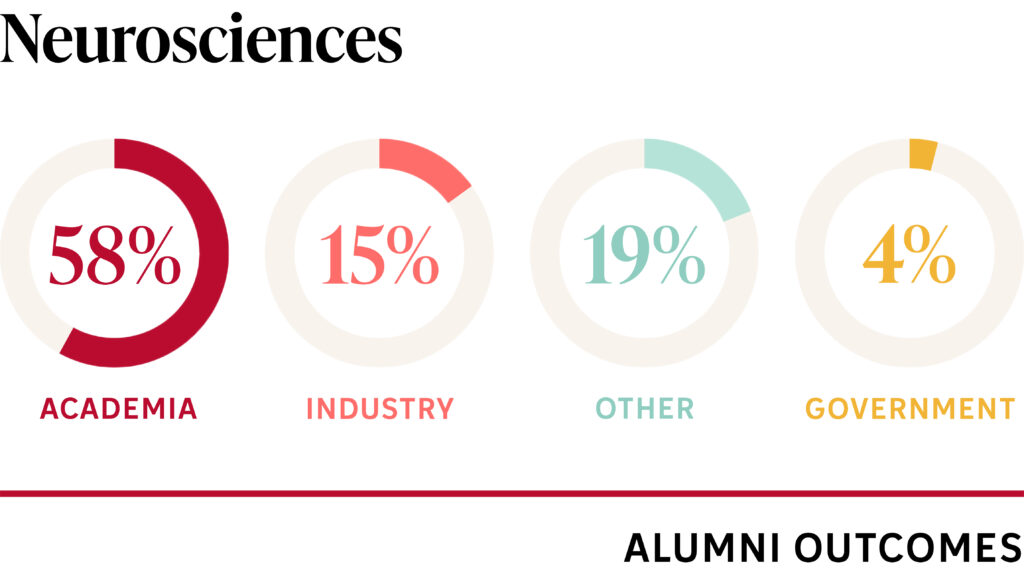
Neurosciences graduates pursue a variety of careers. Most program graduates go into academia, but many find paths in industry, government, and other fields, like science communication, law, and business and entrepreneurship.
Faculty Co-Directors:
Graduate Program Administrator: